



Scientific Reports PubMed Indexing Paused During NLM Review
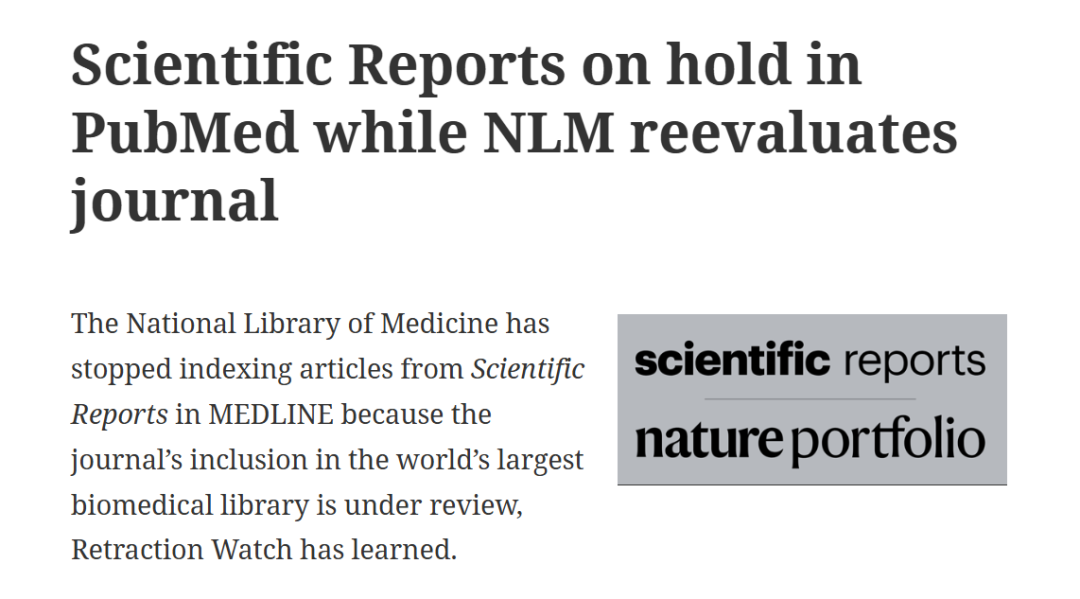
Scientific Reports PubMed indexing has been temporarily paused while the US National Library of Medicine (NLM) conducts a re-evaluation of the journal. The development was reported by Retraction Watch on 30 October 2026, following confirmation from the journal's editorial team.
During the review, newly published content is not being indexed in MEDLINE or archived in PubMed Central (PMC), meaning recent articles are currently unavailable through PubMed via these routes. The situation has raised questions among researchers who rely on PubMed to discover and access biomedical literature.
Why Is Scientific Reports Under Review?
According to Retraction Watch, Scientific Reports is undergoing a re-evaluation by the NLM following its significant growth in recent years.
In an email dated 20 October 2026, the journal's Chief Editor, Rafal Marszalek, confirmed that the journal had been informed of the temporary suspension of new content indexing in MEDLINE and archiving in PMC during the review.
However, the NLM has not publicly confirmed the specific reasons for initiating this assessment.
Its MEDLINE policies state that journals may be re-evaluated when significant changes occur. These can include changes in annual publication volume, the types of articles published, editorial policies and other aspects of publishing practice.
The NLM also considers scientific quality, editorial standards and compliance with established publishing practices when assessing a journal's continued eligibility for MEDLINE indexing.
Although the journal's substantial growth may be relevant to the review, it has not been confirmed as the specific reason for the current evaluation.
How Many Articles Have Been Affected?
The scale of the indexing gap has attracted considerable attention.
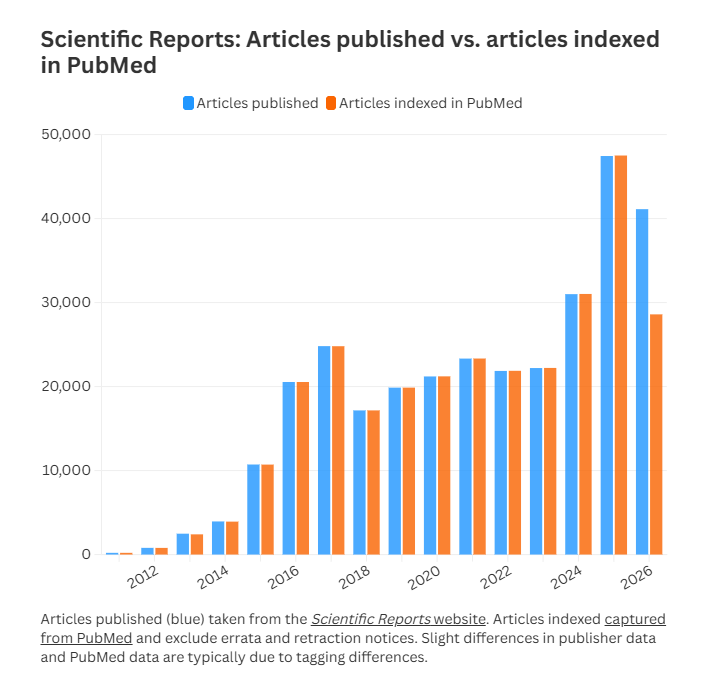
According to figures reported by Retraction Watch on 30 October 2026, the latest Scientific Reports articles appearing in PubMed had publication dates of 15 September 2026.
The report also highlighted the following figures:
-
28,593 articles from Scientific Reports had been indexed in PubMed in 2026, excluding corrections and retraction notices.
-
41,122 publications were listed on the journal's website for the same year at the time of reporting.
The difference between these figures was 12,529 records.
However, these figures come from different sources and may not use identical counting criteria. The difference should therefore not be interpreted as an exact count of articles missing from PubMed solely because of the indexing suspension.
The figures nevertheless illustrate the scale of the journal's publication activity and the potential impact of the temporary interruption.
What Does the NLM Review Mean for Authors?
The suspension may affect researchers who rely on PubMed as a primary resource for finding biomedical and life sciences literature.
Several aspects are worth understanding.
1. Newly Published Articles May Not Appear in PubMed
During the review, newly published Scientific Reports articles are not being added to PubMed through the affected MEDLINE indexing and PMC archiving routes.
This may temporarily reduce the discoverability of recent research among users who primarily search through PubMed.
The suspension does not mean that previously indexed articles have been removed from the database.
2. The Journal Has Not Been Formally Delisted
A temporary indexing hold should not be confused with permanent removal from MEDLINE or PubMed.
Scientific Reports remains under review, and its final indexing status will depend on the NLM's assessment.
The distinction is important for researchers evaluating the journal's current status and considering future submissions.
3. Articles Published During the Review May Be Indexed Later
According to Marszalek, the journal is working with the NLM and expects indexing to resume after the review, including for content published during the current period.
The NLM's official policy also explains that if a journal meets its scientific and editorial standards following re-evaluation, MEDLINE will continue accepting and indexing articles published during the holding period.
However, if the journal does not meet the required standards, the NLM may cease indexing it, and articles published during the suspension period will not be accepted for indexing.
This makes the outcome of the review particularly important for authors whose work is published during this period.
How Long Will the Scientific Reports Review Take?
The NLM's MEDLINE policies indicate that a re-evaluation typically takes around seven to ten months.
The process focuses on recent journal content and may involve an assessment of scientific quality, editorial practices and compliance with MEDLINE requirements.
This is a general timeframe rather than a confirmed completion date for Scientific Reports.
The journal's editorial team has stated that it is cooperating with the NLM and expects indexing to resume once the review is complete. However, no official restoration date has been announced.
Researchers should therefore monitor updates from the journal and the NLM rather than assume that indexing will resume within a fixed period.
What Is Scientific Reports?
Scientific Reports is an open-access multidisciplinary journal published by Springer Nature as part of the Nature Portfolio.
Established in 2011, the journal publishes research across a broad range of disciplines, including natural sciences, biology, medicine, engineering and psychology.
According to the journal's publisher, Scientific Reports has published more than one million papers, while research published in the journal received over one million citations in 2025.
The journal has an extensive editorial network, with more than 11,000 editorial board members. Its article processing charge (APC) is currently US$2,850, subject to applicable taxes and other conditions.
Despite its publication scale and international visibility, its current NLM re-evaluation highlights the importance of maintaining consistent scientific and editorial standards as scholarly publishing continues to expand.
Frequently Asked Questions
Has Scientific Reports been removed from PubMed?
No. The journal is undergoing a temporary re-evaluation by the NLM. The indexing of newly published content in MEDLINE and its archiving in PMC have been paused, but this does not mean that the journal has been permanently removed from PubMed.
Can researchers still access previously published Scientific Reports articles?
Yes. Previously indexed articles remain available in PubMed. The current suspension primarily affects newly published content during the review period.
Why is Scientific Reports being re-evaluated?
The NLM has not publicly disclosed the specific reasons. Its policies identify significant changes in publication practices, including annual publication volume and article types, as possible reasons for re-evaluation.
How long will the NLM review take?
The NLM states that journal re-evaluations typically take around seven to ten months. However, no specific completion date has been announced for Scientific Reports.
Will articles published during the review period eventually appear in PubMed?
That depends on the outcome of the evaluation. If Scientific Reports meets the NLM's requirements, MEDLINE will continue indexing eligible content published during the holding period. Otherwise, those articles may not be accepted for indexing.
Conclusion
The Scientific Reports PubMed indexing suspension highlights the importance of maintaining scientific quality, editorial integrity and transparent publishing practices, particularly for journals experiencing rapid growth.
For researchers, the key issue is not simply whether a journal remains widely recognised, but whether it continues to meet the standards required by major academic databases.
As the NLM review progresses, authors considering submission to Scientific Reports should keep track of official updates and carefully assess how the temporary indexing interruption may affect their research visibility and publication plans.
The outcome of the Scientific Reports PubMed indexing review will be important for both the journal and the wider research community.