




Nature Study Reveals How Diet at Disease Onset Shapes Long-Term Inflammatory Memory
Diet is an important factor in immune regulation, but the long-term effects of short-term dietary changes during an inflammatory episode remain poorly understood. A study published in Nature on 28 October 2026 has identified a critical link between dietary exposure at disease onset and persistent tissue inflammatory memory.
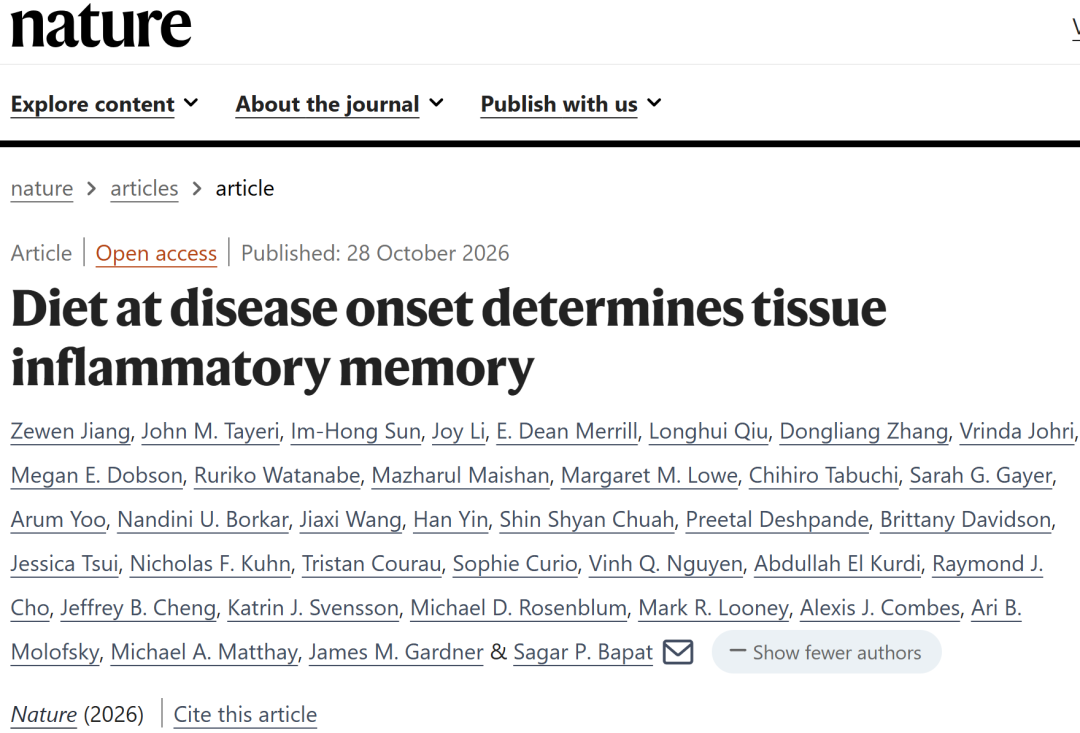
The research, titled "Diet at disease onset determines tissue inflammatory memory", was conducted by a team led by Sagar P. Bapat at the University of California, San Francisco. Using mouse models of acute type 17 (TH17) inflammation, the researchers demonstrated that brief high-fat diet (HFD) exposure during a specific four-day window around disease onset could substantially intensify inflammation and influence subsequent immune responses.
The findings reveal how a temporary nutritional state can have lasting effects on tissue immunity, providing new insights into the relationship between diet, inflammation and immune memory.
A Critical Four-Day Dietary Window Determines Inflammatory Severity
To investigate how dietary conditions influence acute inflammation, the researchers used a mouse model of type 17 skin inflammation that mimics key features of psoriasis.
They found that lean mice exposed to a high-fat diet during the first four days after disease induction developed significantly more severe skin inflammation. The inflammatory response reached levels comparable to those observed in mice with chronic obesity.
Importantly, the effect depended on the timing of dietary exposure. High-fat feeding outside this four-day window did not produce the same inflammatory amplification. Conversely, switching obese mice to a low-fat diet (LFD) during the corresponding period effectively prevented the diet-associated increase in disease severity.
These results identify a distinct four-day peri-initiation window during which dietary conditions can strongly influence the progression of acute inflammation. Rather than being determined solely by long-term body weight or obesity, the inflammatory response was also shaped by the nutritional environment at disease onset.
The Neutrophil–NLRP3–IL-1β Pathway Drives Inflammatory Amplification
The researchers further investigated the cellular and molecular mechanisms underlying the effects of high-fat feeding.
They found that a high-fat diet rapidly promoted the recruitment of neutrophils into inflamed skin. Following an inflammatory challenge, these neutrophils expressed elevated levels of Nlrp3 and Il1b, genes associated with the production and regulation of inflammatory signals.
The functional role of this pathway was confirmed through several experimental approaches. Depleting neutrophils, using genetic methods to disrupt Nlrp3, or pharmacologically inhibiting NLRP3 each substantially reduced the inflammation-amplifying effect of the high-fat diet.
The findings point to a signalling cascade connecting dietary exposure with pathogenic TH17 cell activation:
High-fat diet → Neutrophil recruitment → NLRP3 → IL-1β → Activation of pathogenic IL-1R1⁺ CD4⁺ TH17 cells
This neutrophil–NLRP3–IL-1β axis appears to play a central role in linking the early nutritional environment to an intensified inflammatory response.
Tissue-Resident Memory T Cells Preserve the Effects of Short-Term Dietary Exposure
One of the study's most significant findings concerns the persistence of inflammatory changes after the initial disease episode has resolved.
Following recovery, a population of tissue-resident memory T cells remained in the affected tissue. These cells persisted in a relatively inactive state, with a chromatin configuration that left them poised for subsequent activation.
When inflammation recurred, the memory T cells could be rapidly reactivated, resulting in an exaggerated inflammatory response. This suggests that the immune system retains a record of the conditions present during the initial inflammatory episode.
Notably, the effects were not reversed simply by changing dietary habits after recovery. Mice that had received a high-fat diet during the critical four-day window continued to show enhanced inflammatory responses upon disease recurrence, even when maintained on a low-fat diet afterwards.
The researchers also observed that transient high-fat feeding could amplify TH17-related inflammation in the lungs through neutrophil- and IL-1R1-dependent mechanisms. This suggests that the relationship between early dietary exposure and persistent inflammatory responses may extend beyond skin tissue.
Implications for Research into Chronic Inflammatory Diseases
The study establishes a connection between short-term nutritional exposure and long-term tissue immune memory. It suggests that the timing of dietary changes may be an important factor in determining inflammatory outcomes, particularly when they coincide with the early stages of disease.
For research into TH17-associated inflammatory conditions, including psoriasis and certain forms of asthma, these findings provide a new perspective on how metabolic conditions may influence disease progression and recurrence.
The identification of the neutrophil–NLRP3–IL-1β pathway also highlights potential directions for future therapeutic research. Targeting this signalling axis or the pathogenic TH17 cells it activates may offer strategies for limiting inflammatory amplification and preventing the establishment of persistent tissue inflammatory memory.
However, the findings are based on animal models, and further studies are needed to establish whether the same mechanisms operate in humans. The potential clinical value of dietary interventions during inflammatory episodes also requires investigation.
Overall, this research demonstrates that a temporary dietary exposure can have effects that extend well beyond the period in which it occurs. By identifying a critical nutritional window at disease onset and linking it to long-term immune memory, the study offers new insights into the interaction between metabolism and tissue inflammation.
Reference
Jiang, Z. et al. (2026). "Diet at disease onset determines tissue inflammatory memory." Nature. Published online 28 October 2026.