



AIFE 2026 Concludes Successfully at Waseda University, Tokyo
Tokyo, Japan – June 28, 2026 – 2026 3rd International Conference on Artificial Intelligence and Future Education (AIFE 2026) came to a successful close today at Waseda University, after three days of intensive academic exchange, groundbreaking presentations, and vibrant discussions on the transformative role of artificial intelligence in education.
Hosted by Waseda University and supported by Universiti Teknologi Malaysia (UTM), this year's conference brought together over 50 scholars, researchers, and industry professionals from 9 countries and regions, including China (Mainland), Hong Kong SAR, Taiwan (China), Japan, the United States, Canada, Malaysia, Indonesia, Norway, Spain, and Germany. The event featured a rich program of keynote speeches, invited presentations, and parallel oral sessions, offered both on-site at Waseda University and via an online platform to ensure broad global participation.

Grand Opening and Keynote Addresses
The conference commenced in the morning with an opening ceremony chaired by Tengfei Shao. Prof. Masayuki Goto from Waseda University delivered the opening remarks, warmly welcoming attendees and emphasizing the transformative potential and emerging trends of artificial intelligence in modern education.

The morning session opened with a welcome address followed by an inspiring opening remark delivered by Prof. Masayuki Goto of Waseda University, who set an optimistic and forward-looking tone for the day's proceedings. The session then proceeded with five distinguished keynote addresses, each offering deep insights into the current landscape and future trajectories of AI-powered education.

- Prof. Toru Ishida, Kyoto University
 |
 |
- Prof. Carlos Juiz, University of the Balearic Islands
 |
 |
- Prof. Kuo-Yi Lin, National Kaohsiung University of Science and Technology
 |
 |
- Prof. Katsuyuki Umezawa, Shonan Institute of Technology
 |
 |
- Assoc. Prof. John Maurice Gayed, Waseda University
 |
 |
The keynote topics ranged from the psychological dimensions of agent anthropomorphism in learning environments, to strategic AI governance challenges in higher education, human-centered intelligent decision support, generative AI-enhanced learning paradigms, and the implementation of LLM-based automated writing evaluation systems. Each presentation was followed by engaged Q&A sessions, reflecting the high level of interest and scholarly rigor among attendees.
Afternoon Parallel Sessions: Offline and Online Tracks
The afternoon was dedicated to parallel sessions, with 23 oral presentations delivered across two tracks—offline (in-person) and online—covering a wide array of subjects, including neurosymbolic AI, digital literacy, predictive analytics, educational gamification, AI-assisted language learning, instructional design, and ethical considerations in AI deployment.
In-Person Venue
Featured invited talks by scholars from Henan University of Economics and Law, Johns Hopkins University / Nova Southeastern University, and the King George Vancouver School Board, alongside oral presentations from attending researchers.
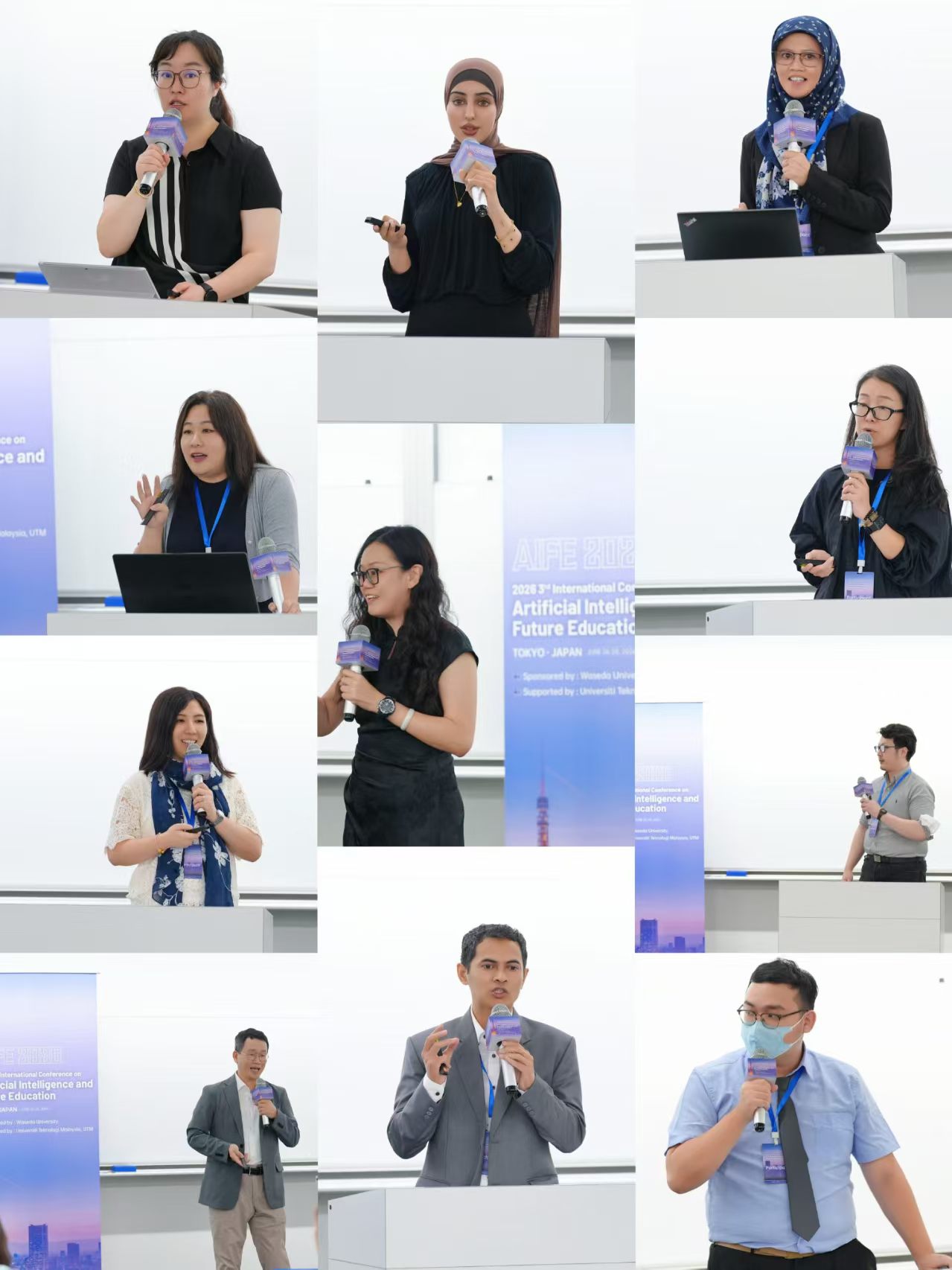
Presenters and their affiliated institutions included:
- The University of Hong Kong
- College of Medicine
- University of Agder
- National Cheng Kung University
- Tunku Abdul Rahman University of Management and Technology
- Universitas Brawijaya
- Macau University of Science and Technology / Ludong University
- Universiti Teknologi Malaysia
- NTT EAST Inc.
Online Venue
Gathered 16 scholars who presented compelling reports on diverse topics within AI and future education, stimulating active Q&A sessions.

Presenters joined remotely from:
- Wuhan Vocational College of Software and Engineering / Wuhan Open University
- Henan University of Economics and Law
- Dalian Neusoft University of Information
- Harbin University of Science and Technology
- Northeastern University
- Anqing Normal University
- Beijing Information Technology College
- Mudanjiang Normal University
- Binary University of Management & Entrepreneurship
- China Three Gorges University
- Beijing City University
Poster Presentation Session
In addition to the oral presentations, AIFE 2026 featured a vibrant poster presentation session showcasing cutting-edge research from scholars across multiple disciplines. The displayed posters covered a diverse range of topics, including:
- Research on the Innovation of Subject Services in University Libraries Driven by Large Language Models – Taking DeepSeek as an Example. Haiyan Feng, Qingrong Guo, Jiyue Liao, Weisheng Chen (Guangdong University of Education; Wuhan University of Technology)
- Research on Intelligent Examination Paper Parsing Framework Based on Multimodal Feature Fusion. Yutong Li, Shanshan Yao, Ke Li
- An Intelligent Detection Method for Violations in Adult Driver Training Based on YOLOv8. Rafiq Liu, Chen Chen (FAIA, School of Information Science and Engineering, Chongqing)
- An Interpretable Context Safety Framework for Detecting Unsafe AI-Generated Content in University Mental Health Services (Character-level TF-IDF, Logistic Regression, and Rule-based Detection)
- Reform of the Talent Cultivation Model for Cross-Border Marketing in the AI-Driven Era Based on K-Means Clustering. Pulizhi Tse, Gishen Li
These poster presentations provided an excellent opportunity for researchers to share their work, exchange ideas, and receive valuable feedback from fellow participants, further enriching the academic atmosphere of the conference.
Award Ceremony and Closing Remarks
The conference concluded with the Outstanding Oral Presentation Award Ceremony, in which five exceptional presenters were recognized by the program committee for their scholarly contributions and presentation excellence.In the closing remarks, the host expressed sincere gratitude to all keynote speakers, invited speakers, oral presenters, and participants for their active engagement and intellectual generosity. Special thanks were extended to Waseda University for hosting the event, Universiti Teknologi Malaysia for its steadfast support, and the dedicated volunteer team for ensuring the smooth execution of both the on-site and online sessions.
 |
 |
Conference Highlights at a Glance
- 50+ participants from 9 countries and regions
- 5 distinguished keynote speeches
- 3 invited presentations
- 23 oral presentations (offline + online)
- 5 outstanding oral presentation awardee
- Multiple poster presentations covering LLMs, multimodal fusion, YOLOv8, AI safety, and K-means clustering applications
 |
 |
 |
Recognition and Looking Ahead
AIFE 2026 has once again affirmed the critical importance of international collaboration in shaping the future of education through artificial intelligence. The conference served not only as a forum for presenting cutting-edge research but also as a platform for building cross-cultural networks and fostering interdisciplinary dialogue.
The organizing committee announced that conference proceedings will be published in due course, and encouraged all participants to stay connected through the official conference network and future announcements.
With the successful conclusion of AIFE 2026, we look forward to welcoming the global AI and education community again at AIFE 2027.