





IEEE ISIT 2026
2026 IEEE International Symposium on Information Theory (ISIT 2026)
June 28 - July 3, 2026 Guangzhou (Guangzhou Yuexiu International Congress Center (GYICC)), China

Online Registration has now closed.
If you wish to attend the conference, you may come to the venue after June 27 at 2:00 PM Beijing Time, where the on-site registration will be opened.
Paper submission deadline: January 16, 2026 (passed)
Acceptance notification: April 1, 2026
Workshop paper submission deadline: April 7, 2026 (firm)
Tutorial proposals submission deadline: February 20, 2026
Early registration start: April 1, 2026
Final manuscript submission: April 20, 2026
Early registration deadline: April 20, 2026
Please join us for the 2026 IEEE International Symposium on Information Theory (ISIT 2026) that will be held in person from June 28 to July 3 in Guangzhou, China.
Welcome to the 2026 IEEE International Symposium on Information Theory (ISIT 2026) that will take place from June 28 to July 3 in Guangzhou, China. This will be the first ISIT in Mainland China, which is warmly anticipated and embraced by the Chinese Information Theory community.
ISIT 2026 invites submission of manuscripts on all classical topics of Information Theory such as Shannon Theory, Coding Theory and Techniques, Information Security, Signal Detection and Estimation, etc. ISIT 2026 also encourages submissions on frontier cross-disciplinary research that blends Information Theory with diverse subjects including but not limited to Bioinformatics, Machine Learning, Artificial Intelligence, DNA Storage and Quantum Information. Some of these topics will be featured by our pilot workshops that aim to bring fresh talents to this flagship conference of the IEEE Information Theory Society. ISIT 2026 will also feature the traditional Shannon Lecture and daily plenary talks, as well as tutorials and social events.
Plenary Talks
| Shannon Lecture Frans Willems (Technische Universiteit Eindhoven, The Netherlands)
|
Bio: Frans M. J. Willems (Life Fellow, IEEE) was born in Stein, The Netherlands, in 1954. He received the M.Sc. degree in electrical engineering from the Technische Universiteit Eindhoven, Eindhoven, The Netherlands, and the Ph.D. degree from the Katholieke Universiteit Leuven, Leuven, Belgium, in 1979 and 1982, respectively. From 1979 to 1982, he was a Research Assistant at the Katholieke Universiteit Leuven. In 1982, he joined the Electrical Engineering Department, Technische Universiteit Eindhoven, where he is currently a Full Professor. He has contributed more than two hundred journal and conference papers and holds several patents. His research contributions are in the areas of multi-user information theory, noiseless source coding, data-embedding, and biometrics. From 1999 to 2016, he was an advisor for Philips Research Laboratories, Eindhoven, for topics related to information theory. From 1998 to 2000, he was a member of the Board of Governors of the IEEE Information Theory Society. From 2014 to 2015, he was a Distinguished Lecturer of the IEEE Information Theory Society. He was a Counselor of the IEEE Student Branch Eindhoven from 2007 to 2014 and was the Chairman of the IEEE Benelux Chapter on Information Theory from 2007 to 2017. More recently, he received a 2011 Best Paper Award from the IEEE Signal Processing Society for the paper “Biometric Systems: Privacy and Security Aspects.” He received the Marconi Young Scientist Award in 1982. He is a co-recipient of the 1996 IEEE Information Theory Society Paper Award for a paper in which the Context-Tree Weighting Algorithm was proposed. From 1988 to 1990, he has served as an Associate Editor for Shannon Theory for the IEEE Transactions on Information Theory. From 2002 to 2006, he was Associate Editor for the Information Theory for the European Transactions on Telecommunications. |
| Plenary Talks Giuseppe Caire (Technical University of Berlin, Germany)
|
Bio: Giuseppe Caire (S '92 -- M '94 -- SM '03 -- F '05) was born in Torino in 1965. He received a B.Sc. in Electrical Engineering from Politecnico di Torino in 1990, an M.Sc. in Electrical Engineering from Princeton University in 1992, and a Ph.D. from Politecnico di Torino in 1994. He has been a post-doctoral research fellow with the European Space Agency (ESTEC, Noordwijk, The Netherlands) in 1994-1995, Assistant Professor in Telecommunications at the Politecnico di Torino, Associate Professor at the University of Parma, Italy, Professor with the Department of Mobile Communications at the Eurecom Institute, Sophia-Antipolis, France, a Professor of Electrical Engineering with the Viterbi School of Engineering, University of Southern California, Los Angeles, and he is currently an Alexander von Humboldt Professor with the Faculty of Electrical Engineering and Computer Science at the Technical University of Berlin, Germany. He received the Jack Neubauer Best System Paper Award from the IEEE Vehicular Technology Society in 2003, the IEEE Communications Society and Information Theory Society Joint Paper Award in 2004, in 2011, and in 2025, the Okawa Research Award in 2006, the Alexander von Humboldt Professorship in 2014, the Vodafone Innovation Prize in 2015, an ERC Advanced Grant in 2018, the Leonard G. Abraham Prize for best IEEE JSAC paper in 2019, the IEEE Communications Society Edwin Howard Armstrong Achievement Award in 2020, the 2021 Leibniz Prize of the German National Science Foundation (DFG), and the CTTC Technical Achievement Award of the IEEE Communications Society in 2023. Giuseppe Caire is a Fellow of IEEE since 2005. He has served in the Board of Governors of the IEEE Information Theory Society from 2004 to 2007, and as officer from 2008 to 2013. He was President of the IEEE Information Theory Society in 2011. His main research interests are in the field of communications theory, information theory, channel and source coding with particular focus on wireless |
| Tara Javidi (University of California San Diego, USA)
|
Bio: Tara Javidi, IEEE Fellow, is the Jerzy Lewak Chair and Professor at UCSD in Jacobs School of Engineering and Halicioglu School of Computing, Information, and Data Science. Her areas of research is in active machine learning, feedback and network information theory, and stochastic control and optimization with applications in the design of wireless and multi-agent networks. She served as the Editor-in-Chief of the of IEEE JSAIT and an elected member of the ITSOC Board of Governors. |
| Wen Tong (Huawei Wireless)
|
Bio: Wen Tong is the CTO, Huawei Wireless, he is the chief scientist for Huawei 5G/6G. He is a Huawei Fellow and an IEEE Fellow. Prior to joining Huawei in 2009, Dr. Tong was the Nortel Fellow and head of the Network Technology Labs at Nortel. He joined the Wireless Technology Labs at Bell Northern Research in 1995 in Canada. For the past three decades, he had pioneered fundamental technologies from 1G to 6G wireless and WiFi. His current research focus is AI-Wireless. He is a Fellow of Canadian Academy of Engineering, and a Fellow Royal Society of Canada. |
| Emanuele Viterbo (Monash University, Australia)
|
Bio: Emanuele Viterbo is a Professor in the Department of Electrical and Computer Systems Engineering at Monash University, where he leads the Software Defined Telecommunications Laboratory. He received his Laurea and Ph.D. degrees in Electrical Engineering from the Politecnico di Torino, Italy. Prior to his academic career, he worked as a patent examiner at the European Patent Office in The Hague, Netherlands (1990-1992), specializing in dynamic recording and error-control coding. This experience provided him with unique insights into the practical applications and intellectual property landscape of coding technologies. Professor Viterbo's research focuses on coding and information theory with applications to modern communication systems. His contributions span lattice codes for wireless channels, algebraic space-time coding, and advanced coding techniques for emerging technologies. More recently, his work has expanded to include information-theoretic approaches to DNA data storage, where he applies coding theory principles to address the unique challenges of storing and retrieving digital information in DNA molecules. His pioneering work in wireless communications has established him as a leading figure in the field, with research that bridges theoretical foundations and practical implementations. He was recognized as an ISI Highly Cited Researcher in 2009, placing his work in the top 1% by citations in his field. In 2011, he was elevated to IEEE Fellow for his contributions to coding and decoding for wireless digital communications. Professor Viterbo has received numerous prestigious fellowships, including the NATO Advanced Fellowship, the Australia-India Fellowship from the Australian Academy of Science, and an Invitation Fellowship for Research in Japan from the Japan Society for the Promotion of Science. Professor Viterbo's expertise in "codes" extends beyond telecommunications. In 1997, he successfully deciphered a unique 250-symbol cipher created by his great-great uncle, an amateur Egyptologist, who had used it to write a 355-page memoir of late 19th-century life. After nearly a century of failed attempts by family members and experts, Professor Viterbo spent three months cracking the code and translating the manuscript. Professor Viterbo has served the IEEE Information Theory Society in multiple leadership roles, including as a member of the Board of Governors, Conference Committee Chair, and General Co-chair of the 2021 IEEE International Symposium on Information Theory. He has also served as Associate Editor for the IEEE Transactions on Information Theory and other leading journals in the field. |





Workshops
>Four Full-day Workshops
Learn to Compress & Compress to Learn Organizers: Jun Chen, Elza Erkip, Yong Fang, Ezgi Ozyilkan
Recent advances in machine learning and artificial intelligence have brought compression back to the forefront of information science. Once regarded primarily as a tool for efficient data storage and transmission, compression has now emerged as a unifying principle linking representation learning, generalization, and efficient communication. This workshop explores how classical information-theoretic concepts—such as rate- distortion tradeoff, minimum description length, and universal compression—are being reimagined and extended in modern contexts like neural source coding, model compression, semantic communication, and generative AI. It aims to foster dialogue between information theorists and machine learning researchers to examine how compression not only enables efficient inference and transmission but also offers a powerful lens for explaining and designing intelligent systems. The program will feature invited talks, contributed presentations, and panel discussions that bridge theory and practice, laying the groundwork for the next generation of compression-inspired learning and communication paradigms.
Q-SAFE 2026: Coding Theory for Post-Quantum Security and Quantum Reliability Organizers: Venkata Gandikota, Ling Liu, Shanxiang Lyu
This workshop focuses on coding theory as a unifying foundation for post-quantum cryptography (PQC) and quantum reliability, highlighting how classical codes, lattices, and decoding algorithms underpin both quantum-safe security and fault-tolerant quantum information processing. The workshop aims to bring together researchers from information theory, coding theory, post-quantum cryptography, and quantum error correction to explore shared mathematical structures and algorithmic principles.
ITGenNexus: Bridging Information Theory and Generative AI Organizers: Yingbin Liang, Jiantao Jiao, Yuheng Bu, Haiyun He, Ziqiao Wang, Peng Wang
Topics (including but not limited to): IT for GenAI (Generalization, Representation, and Reasoning; Compression, Rate-Distortion, and Efficiency; Trustworthiness, Robustness and Security), GenAI for IT (AI Agents for Research; Learning for Classical IT Problems; Modeling, Simulation and Algorithm Design)
Universality and Dynamics in High-Dimensional Learning and Inference Organizers: Rishabh Dudeja, Zhenyu Liao, Junjie Ma, Arian Maleki
High-dimensional learning and inference have recently seen major theoretical advances showing that both learning performance and algorithmic dynamics obey universal mean-field laws. Dynamical mean-field theory provides exact asymptotic descriptions for algorithms such as (stochastic) gradient descent and Langevin dynamics, while Gaussian equivalence and random matrix techniques simplify complex nonlinear random-feature and kernel models into tractable Gaussian surrogates. At the same time, universality and state-evolution analyses for approximate message passing (AMP) and related iterative algorithms, together with new insights into prediction risk and data influence, demonstrate that many seemingly different procedures are governed by the same low-dimensional order parameters. We invite participation in the Universality and Dynamics in High-Dimensional Learning and Inference Workshop at ISIT 2026. This workshop aims to bring together researchers from information theory, machine learning (ML), high-dimensional statistics, random matrix theory, and statistical physics, to develop a unified view of these advances.
>Four Half-day Workshops
Reliable Machine Learning for Wireless Embodied Intelligence Organizers: Khaled B. Letaif, Xinping Yi, Hong Xing, Yunchuan Zhang
Advanced machine learning (ML) models are increasingly deployed in task-critical industrial scenarios, e.g., smart factory, autonomous vehicle/drone/robot networks, with embodied intelligence through wireless interface that integrate computer vision, pattern recognition, sensing, communications and mobile computing. Wireless environment is non-stationary with spatial-temporal varying channels, information feedback distortion, and hardware impairments. These factors make embodied intelligence more challenging, bringing risks such as unpredictable outage during mobility events, unsafe robots navigation due to misspecified models, and corrupted multi-agent coordination due to misaligned scheduling policy. This workshop invites researchers and industry practitioners to present novel theory, performance analysis, and architectural insights that advance deployment- time reliability guarantees of embodied intelligence in wireless networks.
Next-Generation Waveforms Design for Communications, Sensing, and Integrated Systems: Information-Theoretic & Application Perspectives Organizers: Lei Liu, Yuhao Chi, Yao Ge
With the rapid expansion of high-mobility applications, ensuring reliable communication in rapidly time-varying environments has become a critical challenge. Conventional Orthogonal Frequency Division Multiplexing (OFDM) suffers pronounced degradation in such dynamic scenarios, underscoring the urgent necessity for next-generation modulation waveforms. Consequently, emerging multicarrier schemes—including orthogonal time frequency space (OTFS), orthogonal delay division multiplexing (ODDM), orthogonal chirp division multiplexing (OCDM), affine frequency division multiplexing (AFDM), interleave frequency division multiplexing (IFDM), and random multiplexing (RM)—have provided new perspectives for robust system design. This workshop highlights core waveform design challenges at the intersection of information theory and wireless communication, aiming to bridge theory and practice to spur innovation.
Workshop on Coding for New Applications Organizers: Xiao Ma, Richard Wesel, Linqi Song
Since Shannon’s seminal work, coding theory has been a central pillar of information theory and has powered generations of communication systems. Looking ahead, infor- mation processing and communication is moving beyond the classical AWGN-centric paradigm and is increasingly shaped by application-driven requirements. Emerging sce- narios call for advances in coding theory and coded modulation across: i) advanced waveforms such as OTFS, FTN, ODDM, and AFDM exploit delay–Doppler or time– frequency diversity but require waveform-aware code design and decoding; ii) inte- grated sensing and communication (ISAC) systems call for coding strategies that jointly guarantee reliable data delivery and accurate sensing/localization, motivating new trade-off analyses and unified frameworks; iii) coded computing underpins dis- tributed learning, large-scale data processing, and storage by providing straggler re- silience, fault tolerance, and low-latency operation; iv) multi-user access, including NOMA, RSMA, and massive random access, requires both new multi-user code con- structions and the adaptation of classical single-user codes to joint detection/decoding; v) AI-native systems demand information-theoretic and coding tools for compression, efficient/robust training, and interpretability.
Information Theory for Large Language Models (IT4LLM) Organizers: Xueyan Niu, Jun Chen, Bo Bai
The IT4LLM workshop explores the intersection of infor- mation theory and large language models (LLMs), unit- ing researchers to advance both theoretical understand- ing and practical applications. Contemporary AI sys- tems, particularly LLMs, have demonstrated remarkable capabilities, yet they often function as “black boxes,” un- dermining trust, fairness, and efficiency. This workshop will explore information theory as a principled frame- work to advance both the capabilities and interpretability of LLMs, addressing fundamental questions about how information-theoretic principles can guide the develop- ment, optimization, and interpretation of these models.
By integrating core information-theoretic concepts into the design and analysis of LLMs, we aim to deepen our understanding of their behavior, efficiency, and inherent limitations. The interdisciplinary gathering fosters col- laboration between information theorists and machine learning researchers, seeking to uncover how informa- tion theory can provide fundamental insights into the ca- pabilities and limitations of LLMs while simultaneously enhancing their transparency and performance.
Workshop Chairs
Meixia Tao (Shanghai Jiao Tong University) Vincent Tan (National University of Singapore)
Contact: isit2026-workshops@ieee-isit.org
Tutorial Agenda
| Sunday Morning | |||
| Mathematical Theory of In-Context Learning and Chain-of-Thought Capability in Transformers, Shao-Lun Huang (Tsinghua-Berkeley Shenzhen Institute, China) and Yingbin Liang (Ohio State University, USA) | Information Theoretic Aspects of Integrated Sensing and Communication, Kai Wan (Huazhong University of Science and Technology, China), Yifeng Xiong (Beijing University of Posts and Telecommunications, China), and Fan Liu (Southeast University, China) | Generative AI for Radio Access Networks, Lingyang Song, Qingyu Liu, Hongliang Zhang, Shuhang Zhang (Peking University, China) | |
| Sunday Afternoon | |||
| Harnessing Low Dimensionality in Diffusion Generative Modeling: From Theory to Practice, Yuxin Chen (University of Pennsylvania, USA), Qing Qu (University of Michigan, USA), Liyue Shen (University of Michigan, USA), Yuting Wei (University of Pennsylvania, USA) | Electromagnetic Information Theory: Fundamentals, Modeling, Applications, and Future Directions, Linglong Dai (Tsinghua University, China) and Merouane Debbah (Khalifa University of Science and Technology, United Arab Emirates) | Beyond Bits: Semantic Information Theory and Methods, Ping Zhang (Beijing University of Posts and Telecommunications, China), Kai Niu (Beijing University of Posts and Telecommunications, China), Shuo Shao (University of Shanghai for Science and Technology, China) | Fundamentals of Nanopore DNA Sequencing, Brendon McBain and Emanuele Viterbo (Monash University, Australia) |
Mathematical Theory of In-Context Learning and Chain-of-Thought Capability in Transformers,
Shao-Lun Huang (Tsinghua-Berkeley Shenzhen Institute, China) and Yingbin Liang (Ohio State University, USA)
Large Language Models (LLMs) and transformers, as the core architectures underlying today’s frontier generative AI models, have recently revolutionized a wide range of machine learning (ML) applications, including natural language processing (NLP), computer vision, and robotics. Alongside their tremendous experimental successes, theoretical studies from information theory, statistics, and optimization theory, have also emerged to explain the generalizability of LLMs, and why transformers can be trained to achieve fantastic performance, which lead to performance guarantees and algorithm design guidance in practice. In particular, this tutorial aims to provide an overview of these recent theoretical investigations that have characterized the fundamental theory of In-Context Learning (ICL), as well as the training dynamics of transformer-based ML models in Chain-of-Thought (CoT) reasoning. Additionally, the tutorial will explain the primary techniques and tools employed for such analyses which leverage various information theoretical concepts and tools in addition to learning theory, stochastic optimization, dynamical systems, probability, etc. Such techniques not only provide theoretical insights and performance guarantees of LLMs, but also offer design guidance for more effective and interpretable LLM algorithms in contemporary data analytics.
Harnessing Low Dimensionality in Diffusion Generative Modeling: From Theory to Practice,
Yuxin Chen (University of Pennsylvania, USA), Qing Qu (University of Michigan, USA), Liyue Shen (University of Michigan, USA), Yuting Wei (University of Pennsylvania, USA)
Diffusion models have recently gained attention as a powerful class of deep generative models, achieving state-of-the-art results in data generation tasks. In a nutshell, they are designed to learn an unknown data distribution starting from Gaussian noise, mimicking the process of non-equilibrium thermodynamic diffusion. Despite their outstanding empirical successes, the mathematical and algorithmic foundations of diffusion models remain far from mature. For instance: (i) Generalization: it remains unclear how diffusion models, trained on finite samples, can generate new and meaningful data that differ from the training set; (ii) Efficiency: due to the enormous model capacity and the requirement of many sampling steps, they often suffer from slow training and sampling speeds; (iii) Controllability: it remains computationally challenging and unclear how to guide and control the content generated by diffusion models, limiting its ability of solving inverse problems across many scientific imaging applications, as well as raising challenges regarding controllability and safety.
This tutorial introduces a mathematical framework for understanding the generalization and advancing the efficiency of diffusion models by exploring the low-dimensional structures in both the data and the model. We demonstrate how to overcome fundamental barriers to improve the generalization, efficiency, and controllability of diffusion models by exploring how these models adaptively learn underlying data distributions, achieving faster convergence at the sampling stage, and unveiling the intrinsic properties of the learned denoiser. Leveraging theoretical studies, we will demonstrate how to effectively utilize these properties for guiding the generation of diffusion models for solving scientific problems.
Information Theoretic Aspects of Integrated Sensing and Communication,
Kai Wan (Huazhong University of Science and Technology, China), Yifeng Xiong (Beijing University of Posts and Telecommunications, China), and Fan Liu (Southeast University, China)
Integrated sensing and communication (ISAC), well-recognized as a key enabling technology for future 6G wireless networks, is fundamental to many modern technologies and applications, driving advancements in fields like IoT, smart cities, healthcare, and industrial automation. Overall, ISAC provides significant enhancements in performance and resource efficiency compared to individual sensing and communication systems, primarily attributed to the collaborative use of wireless resources, radio waveforms, and hardware platforms. However, sensing and communication operate on distinct information processing principles. Thus, a number of performance tradeoffs between sensing and communication exist, ranging from information theoretical limits to physical layer performance tradeoffs, and to cross-layer design tradeoffs. Information theory has recently developed some promising tools to characterize the fundamental tradeoffs between sensing and communication in prototypical relevant settings. This tutorial aims to provide a comprehensive understanding on the recent information theory results in ISAC problems, and also to shed light on many important but open problems in the context of sensing and communication tradeoffs. In this half-day tutorial, we will firstly overview the background and application scenarios of ISAC. Then we will provide a brief review on theoretical background for ISAC, and on the evolution of information theoretic results related to ISAC. As a step further, we will present an overview on the fundamental limits of various ISAC models. Then two technical parts will be introduced with details: 1) fundamental tradeoffs between communication and sensing, and 2) applications to realistic signal processing. Finally, we will conclude the tutorial by summarizing the future directions and open problems in the area of information theoretic ISAC.
Electromagnetic Information Theory: Fundamentals, Modeling, Applications, and Future Directions,
Linglong Dai (Tsinghua University, China) and Merouane Debbah (Khalifa University of Science and Technology, United Arab Emirates)
To significantly improve the system performance of 6G wireless communications, various promising technologies, such as reconfigurable intelligent surfaces (RISs), holographic multiple-input multiple-output (HMIMO), orbital angular momentum (OAM), and near-field communications, have been recently investigated. All these technologies attempt to explore new degrees of freedom (DoF) to achieve performance gains. Actually, the expected performance gains come from more accurate understanding and precise manipulation of electromagnetic fields carrying information. However, the classical information theory abstracts out the physics of the electromagnetic propagation, yielding results within the context of a given simple yet elegant mathematical model at the price of hiding some physical insights. Therefore, integrating classical electromagnetic theory and information theory is of great importance to capture the physically consistent fundamental limit of wireless communications, which leads to the interdisciplinary subject called electromagnetic information theory (EIT).
As an emerging interdisciplinary subject, EIT faces many problems and challenges, such as the establishment of physically consistent transmission models, the corresponding theoretical limits of communication systems, and the possible new designs and paradigms of communication systems. To address these challenges, this tutorial will introduce the latest progress of EIT from both theoretical and practical perspectives. First, this tutorial will introduce the motivations and definitions of EIT. It is developed as a theory that can model and analyze the real-world electromagnetic wireless information system with physically interpretable and mathematically reasonable assumptions. By utilizing stochastic processes, operator theory, Slepian’s concentration problem, and Fredholm determinant, EIT can derive the physically consistent DoFs and mutual information upper bounds of wireless communication systems more accurately. Subsequently, this tutorial will present the techniques enabled and inspired by EIT, respectively. Finally, we will predict the future research trends of EIT.
Generative AI for Radio Access Networks,
Lingyang Song, Qingyu Liu, Hongliang Zhang, Shuhang Zhang (Peking University, China)
With the rapid growth of the demands in modern wireless applications, the limitations of conventional radio access networks (RAN) in handling the complexity, scalability, and performance demands of wireless networks have become apparent. Recent advancements in generative artificial intelligence (AI), e.g., large foundation models, lead to a significant shift in how wireless networks are designed, managed, and optimized. The integration of generative AI and RAN heralds a transformative era, enabling the development of more adaptive, intelligent, high-performing, efficient, and versatile network systems. Generative AI-enhanced RAN is a key enabler for next-generation wireless networks like 6G, where the complexity and demand for high performance require advanced automation and intelligent management. This tutorial will present the basic concepts/theories for addressing the research advances of generative AI for RAN.
Beyond Bits: Semantic Information Theory and Methods,
Ping Zhang (Beijing University of Posts and Telecommunications, China), Kai Niu (Beijing University of Posts and Telecommunications, China), Shuo Shao (University of Shanghai for Science and Technology, China)
This tutorial presents a survey of semantic information theory and methods beyond Shannon. We will first introduce ComAI, a new communication paradigm that converges communication and native AI. The system architecture of ComAI, inspired by human intelligence, and its key technologies will be subsequently provided, and then the its essences will also be discussed, elaborating the relationships among communication, intelligence, and semantic information.
Then, we focus on semantic information theory, which serves as the core guiding principle for ComAI. We first review the historical development roadmap of semantic information perspectives, followed by an introduction of a synonymy-based viewpoint as our focus. Building on this foundation, we establish semantic information measures, fundamental coding theorems, and corresponding semantic coding limits, and develop a synonymous mapping optimization analysis framework to guide the design and optimization of semantic coding methods for semantic compression and transmission. Together, these results form a unified theoretical system that provides principled support for semantic communications.
Finally, we extend the semantic information theory to lossy coding scenarios where the semantic information and the observable source follows a probabilistic rather than deterministic relationship. The rate distortion function and the finite blocklength analysis of the semantic information theory will be discussed. The quadratic Gaussian case will be leveraged as an illustrative example to show that this line of research has the potential to produce many theoretical results with practical implications.
Fundamentals of Nanopore DNA Sequencing,
Brendon McBain and Emanuele Viterbo (Monash University, Australia)
DNA-based data storage is an emerging technology with the potential to store the world’s rapidly growing digital information—which approximately doubles each year—while preserving existing data over long time horizons. A central component of any DNA storage system is the readout process (DNA sequencing). This tutorial provides a deep dive into the fundamental operation of the nanopore DNA sequencer and current research on nanopore read channels, which have attracted growing interest in the coding and information theory community due to the rich modelling and decoding challenges they present. The tutorial begins with a brief introduction to DNA data storage, then narrows to nanopore sequencing and covers key topics including nanopore chemistry, simulation and channel modelling, achievable rates, code construction, and decoding algorithms. Open problems in nanopore sequencing will be discussed, and promising research opportunities will be highlighted.
Venue
ISIT 2026 will take place at Guangzhou Yuexiu International Congress Center (GYICC).
Locating in the city center, Guangzhou Yuexiu International Congress Center (GYICC) is in the heart of Liuhua Business Area, with mature supporting facilities and convenient transportation.
 |
No. 119 Liu Hua Road, Yuexiu District, Guangzhou, China. It is surrounded by three eco-parks of the district with two five-star hotels around. It can be easily reached through Guangzhou Metro Line 2 (Yuexiu Park Station Exit B2 or Exit C). About a 30-minute drive to Guangzhou Baiyun International Airport. About a 45-minute drive to Guangzhou South Railway Station. About a 10-minute drive to Guangzhou Railway Station. About a 20-minute drive to Guangzhou East Railway Station. |
Accomodation
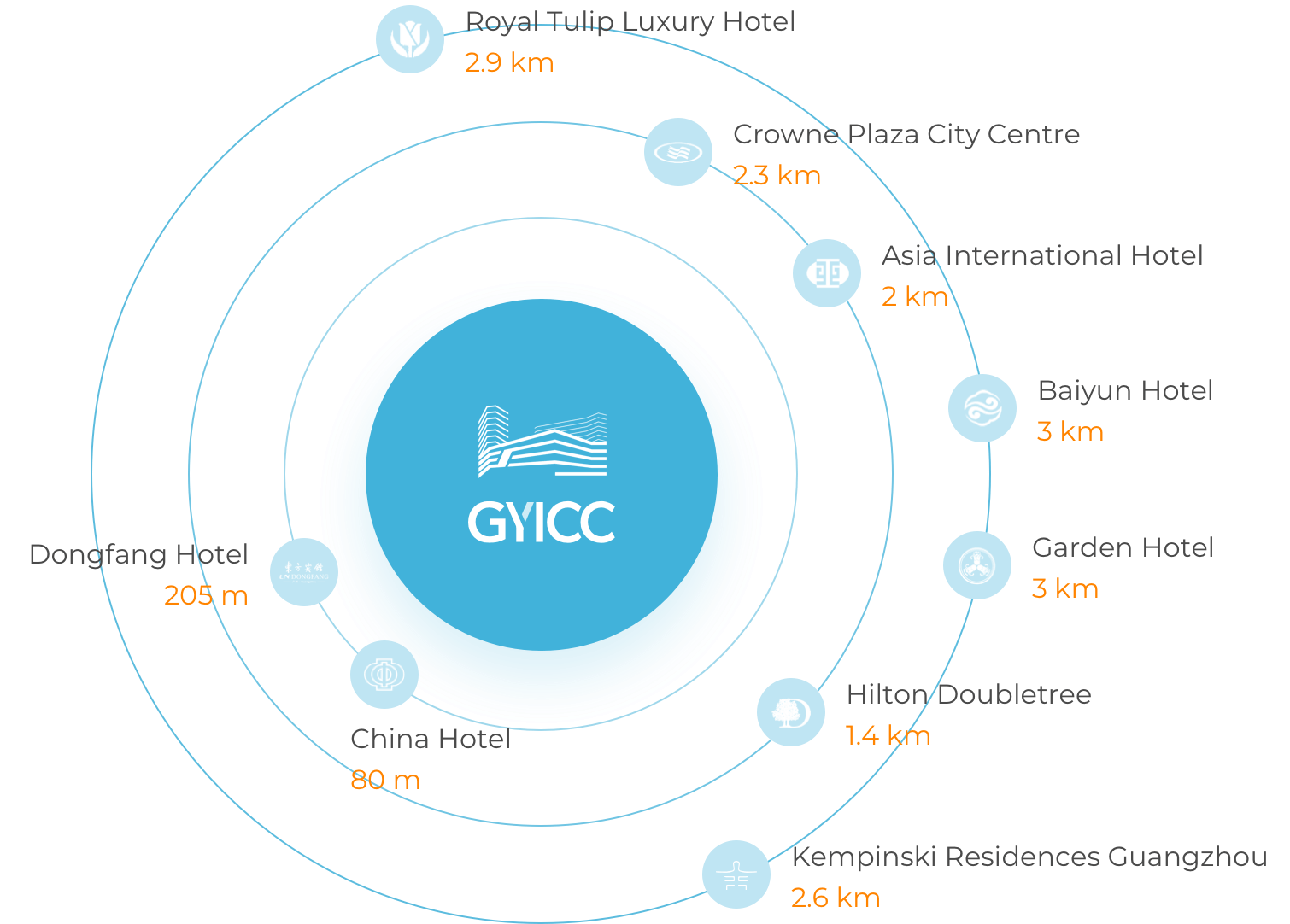 |
Within 3km of GYICC, there are: 9 five-star hotels 4657 rooms in total. 2 of them only 100m far away 19 four-star hotels, 2812 rooms in total 30 three-star hotels, 4184 rooms in total. Dong Fang Hotel Guangzhou
China Hotel
|


Contacts
Questions about the paper submission process should be directed to the publications chairs: isit2026-publications@ieee-isit.org
For general inquiries please contact isit2026@ieee-isit.org
About transfer or refund, please contact Mandy YU (E-mail: 3329712416@qq.com)
Other points of contact are:
Technical Program Chairs: isit2026-techprogramchairs@ieee-isit.org
Satellite Workshops Chairs: isit2026-workshops@ieee-isit.org
Sponsorship Chair: isit2026-sponsorship@ieee-isit.org
Student Travel Grant Chairs: isit2026-travelgrants@ieee-isit.org
Recent Results Chairs: isit2026-recentresults@ieee-isit.org
Registration: isit2026-registration@ieee-isit.org
Tutorial Chairs: isit2026-tutorials@ieee-isit.org
Publications Chairs: isit2026-publications@ieee-isit.org